Cataract Surgery San Diego, CA
What is a Cataract?
As we age, our eyes undergo changes, and one of the most common conditions that affect seniors is cataracts. A cataract occurs when the lens in the eye becomes cloudy, making it difficult to perform daily tasks such as reading, driving, and even recognizing faces. It’s a natural process that occurs slowly over time, and while it may be frustrating, it’s important to know that you’re not alone. The cloudiness in the lens can make it seem like you’re looking through a frosted window, which can be especially frustrating when you’re trying to enjoy the beautiful scenery around you. As the cataract progresses, it can lead to significant vision loss and even blindness. However, with the right treatment and care, you can continue to enjoy your daily activities and maintain your independence.
What causes Cataracts?
Cataracts often develop slowly over time and do not typically cause pain. However, certain factors can speed up the development of cataracts, including long-term use of corticosteroids, smoking, and exposure to UV light. Additionally, medical conditions like alcoholism and diabetes mellitus can also contribute to cataract formation. It’s important to be aware of these risk factors and take steps to protect our eyes as we age, such as wearing sunglasses and getting regular eye exams. By taking care of our eyes, we can continue to enjoy our favorite activities and maintain our independence as we age.
How will I know if I have a Cataract?
Many people have cataracts without knowing it. This is because in the early stages the cataract doesn’t interfere with vision. As the lens gets thicker, it has more power within the eye that can actually improve reading vision, which is sometimes called “second sight.” With time, the lens becomes cloudier and may cause a gradual blurring of vision. This is often noticed as difficulty reading road signs or reading the scroll on the bottom of the TV screen. Night driving can also be affected and halos around lights are often seen. Sensitivity to bright lights and decreased vision in bright light are common complaints of people with cataracts. The ability to distinguish or perceive colors may also be impaired

Cataract Symptoms
Blurry Vision or Cloudiness
- Double vision
- Colors seem faded
- Glare or halos
- Light Sensitivity
Cataract Treatment
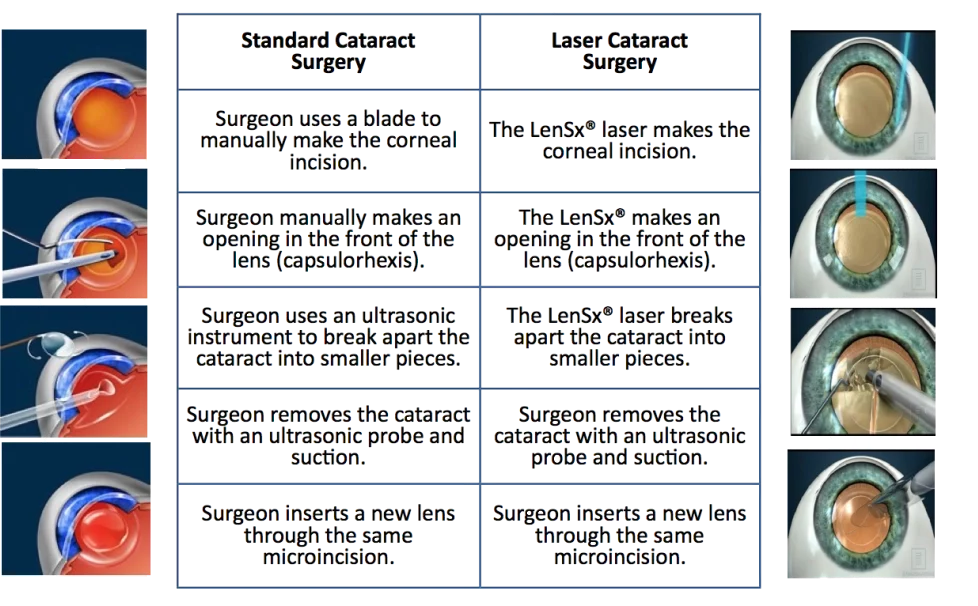
When it comes to early-stage cataracts, changing your glasses prescription can sometimes help improve vision temporarily. However, there are no medications or eye drops that can effectively treat cataracts. If cataracts are interfering with your daily activities, it may be time to consider cataract surgery. During the procedure, our skilled surgeon, Dr. Fahad Khan makes a tiny incision and removes the cloudy lens using a process called “phacoemulsification,” which uses ultrasound power to liquefy the lens so it can be withdrawn from its sac. An artificial lens called an intraocular lens (IOL) is then placed in the eye to replace the old lens. While older IOLs were fixed for one distance and required glasses after surgery, there are now many different lens options available. Dr. Khan will help you choose the best lens for your individual needs and lifestyle. Don’t let cataracts interfere with your quality of life – take the first step towards clearer vision by scheduling a consultation with our team today.
If you’re experiencing vision problems, astigmatism could be the cause. Astigmatism occurs when the cornea has an irregular shape, causing light rays entering the eye to scatter instead of focusing on a single point. Fortunately, our team uses the latest state-of-the-art technology to diagnose astigmatism at all levels. One of the tests we use is called corneal topography, which involves using a special camera to photograph the corneal pattern. This produces a detailed map that shows the size, shape, and steepness of the cone. Another test we use is called Pentacam, which provides a precise analysis of the central cornea by scanning the front segment of your eye. These tests are quick, painless, and will be performed before your cataract surgery to ensure that your vision is properly diagnosed and treated. Don’t let astigmatism interfere with your daily life – schedule an appointment with us today to get started on the path to clearer vision.
Treating Astigmatism Using AK
After diagnosing astigmatism using our advanced corneal topography and Pentacam tests, Dr. Fahad Khan, our resident trained specialist, can perform a procedure called astigmatic keratotomy during your cataract surgery to reduce the condition. Using the information from the corneal scans, he can make a carefully planned surgical incision in the eye with precision. This 1/10th-inch incision uses a self-sealing technique that eliminates the need for stitches. After the procedure, the shape of the cornea will be more rounded, like a basketball, rather than irregular, like a football. This can significantly reduce your dependence on glasses for distance vision after surgery, though you may still need reading glasses for fine print. Our goal is to help you see clearly and comfortably, and astigmatic keratotomy can be an important step in achieving that.
Toric Lens
Vision Specialists of California offers an advanced lens called the AcrySof toric lens that corrects astigmatism while also clearing vision from cataracts. Without this lens, additional surgery or corrective eyewear (as discussed in the section on AK above) is necessary to reduce blurring and distortion caused by astigmatism. The unique design of the AcrySof toric lens reduces or eliminates corneal astigmatism, improving uncorrected distance vision. However, patients will still require reading glasses for near vision.
Revolutionary Lenses
Vision Specialists of California and Dr. Fahad Khan are recognized as leaders in the greater San Diego area for cataract surgery and lens replacement. At the time of cataract surgery, you can choose to have your natural lens replaced with either a traditional single focus intraocular lens (IOL), a multifocal intraocular lens, or a toric lens, which is referred to as an advanced technology lens.
Multifocal Lenses
Certain advanced technology lenses come with trifocals built-in, which offer clear vision for all distances, without the need for glasses or contact lenses. Patients who opt for advanced technology lenses generally experience visual freedom after the procedure, enabling them to see both near and far without relying on glasses. This type of lens provides the highest degree of independence from glasses.
At Vision Specialists of California, our cataract surgeons are experts at advanced cataract surgery and use a variety of state of the art ultra intra ocular lenses from the worlds leading manufacturers. Such as some of these below: